

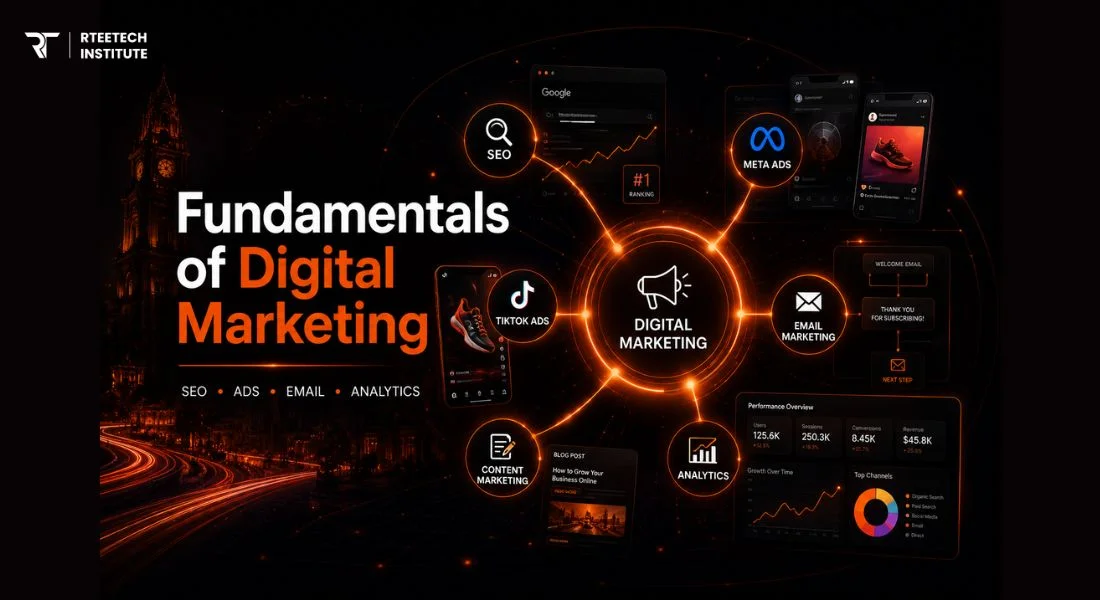
What are the fundamentals of digital marketing, and why do some businesses succeed online while others struggle to get results?
The fundamentals of digital marketing are the core principles that help businesses attract, engage, and convert customers through SEO, content marketing, social media, email marketing, and paid advertising. These fundamentals form the foundation of every successful digital marketing strategy.
In this guide, you'll learn how these fundamentals work together, why they matter, and how to build a strong foundation for long-term digital marketing success.
What Are the Fundamentals of Digital Marketing?
The fundamentals of digital marketing are the essential principles that help businesses attract, engage, convert, and retain customers through online channels. These fundamentals include SEO, content marketing, social media marketing, email marketing, paid advertising, analytics, and understanding the customer journey. Mastering these core concepts helps beginners build effective marketing strategies, improve campaign performance, and achieve long-term business growth.
What Is Digital Marketing, Actually?
Digital marketing is the process of reaching, engaging, and converting customers through online channels. It includes search engines, social media platforms, email, paid advertising and content any channel where people spend time online.
The keyword is channels plural. Digital marketing is not one thing. It is a system of interconnected disciplines that work together to move a person from not knowing your brand exists to becoming a paying customer. Understanding that system how the pieces connect is the first fundamental every beginner needs to build.
Organic vs Paid - The Two Sides of Digital Marketing
Every digital marketing activity falls into one of two categories. Understanding the difference shapes every strategic decision you make.
Organic marketing builds visibility without paying for placement. SEO gets your website ranking on Google without ad spend. Social media content grows your audience without boosting.
Email marketing reaches your existing subscribers for free. Organic results take longer to build but compound over time a page that ranks on Google today keeps bringing traffic for months or years without additional cost.
Paid marketing buys visibility immediately. Meta Ads, TikTok Ads, Snapchat Ads, and Google Ads put your content in front of a targeted audience the moment you activate a campaign. Paid results are fast and precise but stop the moment your budget runs out.
The best digital marketing strategies use both together. Paid advertising generates immediate traffic and revenue while organic efforts build long-term equity. Neither works as well in isolation as they do in combination.
The Digital Marketing Funnel - How Customers Actually Move?
One of the most important fundamentals in digital marketing is understanding how customers move from first awareness to purchase. The funnel model breaks this journey into three stages.
TOFU - Top of Funnel This is where awareness begins. Your audience at this stage has never heard of your brand. The goal is not to sell it is to reach and educate.
Brand awareness campaigns, organic content, and informational SEO articles all operate at this stage. Budget allocation here is typically around 40 percent of your total marketing spend.
MOFU - Middle of Funnel This stage nurtures people who have already interacted with your brand, watched a video, visited your website, or engaged with a post.
They know you exist but have not bought yet. The goal is to build trust and move them closer to a decision through engagement campaigns, lead magnets, email sequences, and educational content.
BOFU - Bottom of Funnel This is the conversion stage. Your audience here is warm, they have shown clear interest and are close to a decision. Retargeting campaigns, abandoned cart sequences, and conversion-focused ads run here. This is where metrics like ROAS and CPA are measured and where revenue is generated.
Most beginners run only bottom-of-funnel campaigns and then complain that their ads are expensive and their audience is exhausted. Building audiences at TOFU and nurturing them through MOFU is what makes BOFU campaigns cost-effective and scalable.
The Core Digital Marketing Channels
These are the channels that every trained digital marketer needs to understand and eventually execute across.
Search Engine Optimization (SEO) SEO drives organic traffic from Google. When someone searches for a product or service you offer, SEO determines whether your website appears at the top of results or on page five.
It covers keyword research, on-page optimization, technical fixes, local SEO for location-based searches, and link building for authority. SEO results take time but deliver compounding returns that paid ads cannot replicate.
Social Media Advertising Meta, TikTok, Snapchat Paid social advertising lets you reach precisely targeted audiences based on demographics, interests, behaviors, and previous interactions with your brand.
Meta Ads cover Facebook and Instagram. TikTok Ads reach younger audiences through its unique Interest Graph model. Snapchat Ads access a 13 to 34 year old demographic through Story Ads, AR Lenses, and Geofilters. Each platform has its own ad manager, pixel tracking system, and creative requirements.
Email Marketing Email delivers approximately $36 return for every $1 spent the highest ROI of any digital channel. It works through list building, audience segmentation, automated sequences like welcome flows and abandoned cart recovery, and ongoing broadcast campaigns. Unlike social media, you own your email list and no algorithm decides whether your message reaches your audience.
Content Marketing Content is the fuel that makes every other channel work. Blog articles support SEO. Social media posts build organic reach. Video content powers TikTok and Reels. Email newsletters retain subscribers.
A content strategy built on the 3E framework - Educate, Entertain, Engage ensures your content serves both your audience and your business goals simultaneously.
Analytics and Performance Measurement Every digital marketing decision should come from data. The key metrics every beginner needs to understand are CPM (cost per thousand impressions), CPC (cost per click), CTR (click-through rate), CPA (cost per acquisition), and ROAS (return on ad spend).
Google Analytics 4 and platform-specific dashboards like Meta Ads Manager track these metrics and show you exactly where your campaigns are working and where they are not.
Key Terms Every Digital Marketing Beginner Needs to Know
These terms appear constantly in digital marketing understanding them from the start saves hours of confusion later.
Conversion Any action you want a user to take a purchase, a sign-up, a form fill, a call. The entire point of most digital marketing activity is to drive conversions at the lowest possible cost.
Pixel A small piece of tracking code placed on a website that tells advertising platforms like Meta and TikTok what visitors do after clicking an ad. Without a properly configured pixel, your campaigns cannot optimize for results or retarget warm audiences.
CAPI (Conversion API) A server-side tracking method that sends conversion data directly from your server to the advertising platform, bypassing browser restrictions caused by iOS privacy updates. In 2026, running Pixel without CAPI means incomplete data and underperforming campaigns.
Lookalike Audience An audience that an advertising platform builds by finding new users who share characteristics with your existing customers. Meta and TikTok use AI to identify these patterns. 1 percent lookalikes are the most precise and typically the best-performing.
A/B Testing Running two versions of an ad, email, or page with one variable changed different headlines, different images, different CTAs to determine which performs better. Every optimization in digital marketing comes from testing, not guessing.
Retargeting: Showing ads specifically to people who have already interacted with your brand visited your website, watched your video, or engaged with your content because they are significantly more likely to convert than cold audiences.
How These Fundamentals Connect in Practice?
Understanding each concept separately is useful. Understanding how they work together is what makes you effective.
A complete digital marketing campaign starts with content and SEO building organic awareness at the top of the funnel. Paid social ads on Meta, TikTok, and Snapchat accelerate awareness and drive traffic. Pixel and CAPI track every interaction.
Custom Audiences capture warm traffic for retargeting. Email marketing nurtures leads who did not convert immediately. Analytics from GA4 and platform dashboards show what is working, what needs adjustment, and where the budget should move next.
Each piece supports every other piece. That is the system and understanding it at a fundamental level is what allows you to build campaigns that produce consistent results rather than occasional wins.
Where to Learn Digital Marketing Fundamentals Properly in Faisalabad?
Understanding the fundamentals conceptually is step one. Applying them on real campaigns, with real budgets and real data, is where skill actually develops.
At Rteetech Institute, the Advanced Digital Marketing Mastery Program builds every module on this foundational understanding starting with digital marketing fundamentals and full-funnel strategy in Module 01 before moving into Meta Ads, TikTok Ads, Snapchat Ads, email marketing, SEO mastery, and freelancing.
You do not just learn what these channels are, you execute them on live projects from the first week.
If you want to explore what a complete digital marketing education looks like, our digital marketing guide covers the full picture.
And if you want to compare your options before committing, our best digital marketing courses guide gives you the criteria to evaluate any program.
The full program details are on our digital marketing course page.
Final Thoughts
The fundamentals of digital marketing are not complicated but they are foundational. Every advanced tactic, every platform-specific strategy, and every campaign optimization you learn later connects back to these core concepts.
Understand the funnel. Know the difference between organic and paid. Speak the language of performance metrics and see digital marketing as a system, not a collection of separate tools.
Get these right and everything else becomes easier to learn, faster to apply, and more effective in practice.
FAQs
What is the difference between digital marketing and traditional marketing?
Traditional marketing uses offline channels like TV, print, and billboards digital marketing uses online channels where targeting is precise, results are measurable in real time, and campaigns can be adjusted while they run.
Does learning digital marketing fundamentals require a technical background?
No, the fundamentals cover strategy, channels, and concepts that anyone can learn regardless of their educational or professional background.
What is the most important digital marketing fundamental for beginners to learn first?
The full-funnel model understands TOFU, MOFU, and BOFU because it gives every other tactic a strategic context and prevents the most common beginner mistake of running only conversion campaigns on cold audiences.
How long does it take to understand the fundamentals of digital marketing?
With structured, practical training, most beginners develop a solid working understanding of the fundamentals within the first two to three weeks enough to start executing basic campaigns and understanding the results.
Is the Google Digital Garage fundamentals course enough to start a digital marketing career?
It builds useful conceptual knowledge and provides a recognized free certificate but it does not include hands-on campaign practice, structured progression across all channels, or career support, which structured training provides.